
Your dentist looks at your X-ray and pauses. The image shows something but not clearly enough to be certain. It could be a hairline fracture. It could be an infection tracking along a root. It could be nothing. Without more information, the only way to know is to guess, wait, or look deeper.
That is exactly the situation a dental CT scan is designed to resolve.
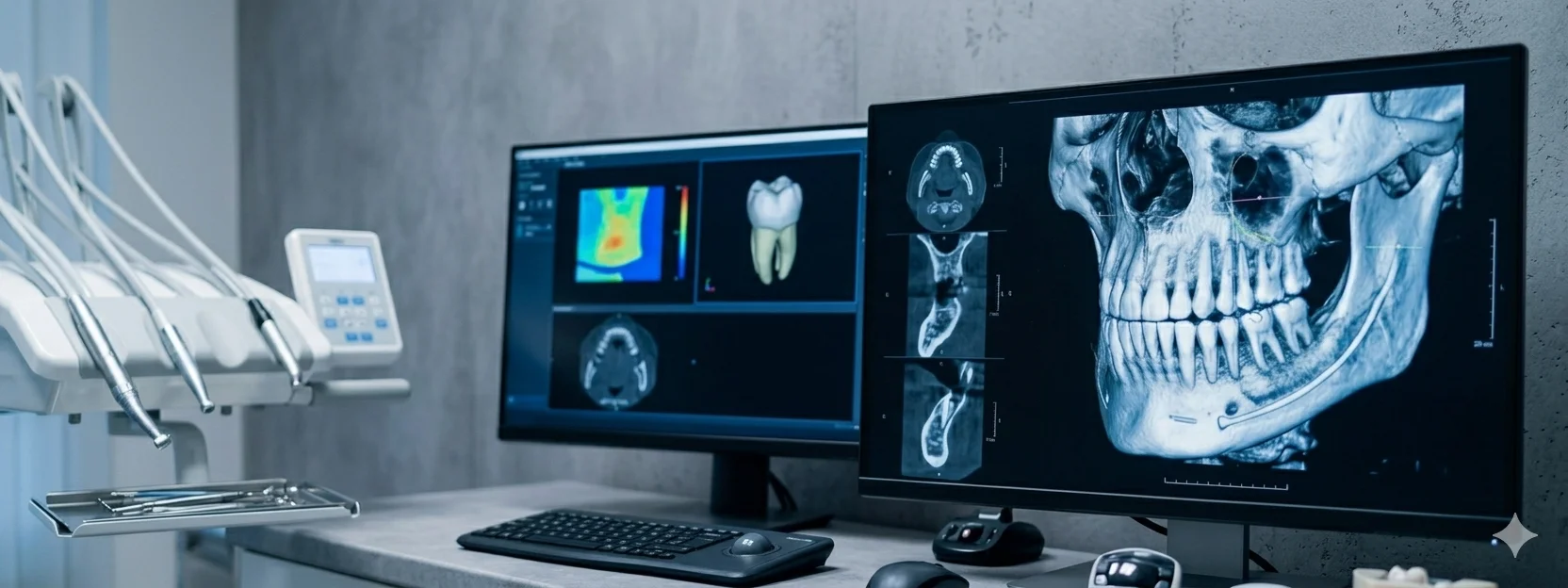
A dental CT scan more precisely called a CBCT scan, or Cone Beam Computed Tomography gives your dentist a detailed, three-dimensional image of your teeth, jawbone, nerves, sinuses, and surrounding structures. Not a flat picture. A complete view, from every angle, at a level of detail that standard X-rays cannot provide. At Acer Dental Clinic, our CBCT radiology reports are prepared by an in-house maxillofacial radiologist and delivered within three working days.
Here is what it is, when you need one, and what it means for your treatment.
What Is a Dental CT Scan, Exactly?
A standard dental X-ray captures a two-dimensional image. It is useful for many things spotting decay between teeth, checking the length of roots, identifying obvious bone changes but it compresses a three-dimensional structure into a flat image. Depth is lost. Overlapping structures hide each other. Fine detail disappears.
A dental CT scan works differently. The CBCT machine rotates around your head in a single pass taking between 20 and 40 seconds capturing hundreds of images from different angles simultaneously. That data is reconstructed by computer software into a full three-dimensional model of your jaw and facial structures.
The resulting images can be viewed as 3D reconstructions or as precise cross-sectional slices in any direction axial, coronal, sagittal. Your dentist or specialist can rotate, zoom, and examine every millimetre of the area in question, with no overlapping structures obscuring the view.
The difference between a standard X-ray and a dental CT scan is roughly the difference between a map and a satellite image.
When Do You Need a Dental CT Scan?
Not every dental appointment requires a CT scan and a good clinic will never recommend one unless there is a clear clinical reason. But there are specific situations where standard imaging is simply not sufficient, and proceeding without a CT scan increases the risk of a poor outcome significantly.
- Dental implant planning: this is one of the most common reasons for a dental CT scan. Before placing an implant, your surgeon needs to know the exact height and width of available bone, the precise location of the inferior alveolar nerve and maxillary sinus, and whether the bone density is sufficient at the planned site. Without this information, implant placement is guesswork. For more on how implants are planned at Acer, see our dental implants page.
- Complex root canal treatment: some teeth have unusual root canal anatomy extra canals, curved roots, calcified passages that a standard X-ray will not reveal. A dental CT scan can identify root canal morphology in detail, show accessory canals, and help the endodontist plan an approach that a flat image would have missed entirely. Learn more about our root canal treatment approach.
- Impacted or wisdom teeth: when a wisdom tooth or other impacted tooth is near the inferior alveolar nerve or maxillary sinus, a panoramic X-ray may show proximity but cannot confirm the exact relationship. A CT scan provides the three-dimensional view needed to extract safely and avoid nerve damage.
- Suspected cracked teeth: cracks in teeth are notoriously difficult to diagnose. They may not be visible clinically or on conventional X-rays. CBCT’s high-resolution 3D imaging can detect fine cracks from multiple angles, helping confirm a diagnosis that would otherwise require exploratory treatment.
- Unexplained pain or infection: when a patient presents with pain that does not match any obvious clinical finding, or when an infection appears to involve deeper structures, a CT scan can reveal what standard imaging cannot periapical lesions, bone involvement, cysts, or conditions in the sinuses and surrounding tissues.
- Orthodontic and jaw assessment: for complex orthodontic cases, a dental CT scan allows three-dimensional cephalometric analysis, assessment of jaw asymmetry, and airway evaluation information that is critical for treatment planning and outcomes, particularly where jaw surgery may be involved.
- TMJ evaluation: the temporomandibular joint the jaw joint can only be properly assessed in three dimensions. CT imaging allows evaluation of morphological changes in the joint, bony defects affecting the condyle, and conditions that a standard X-ray cannot capture.
What Happens During a Dental CT Scan?
The process is quick, straightforward, and non-invasive. Before the scan, you will be asked to remove any jewellery, glasses, or metal objects that could interfere with imaging. A lead apron is provided for protection.
You are positioned in the CBCT machine seated, standing, or lying down depending on the equipment with your head stabilised using a chin rest and positioning aids to minimise movement. The machine arm rotates around your head once, taking approximately 20 to 40 seconds. You simply stay still.
The data captured is then processed into a three-dimensional image by specialised software. The scan itself causes no discomfort. Most patients describe it as significantly less intrusive than they expected.
After the scan, the images are reviewed and interpreted by a maxillofacial radiologist a specialist trained specifically in imaging and diagnosis of the jaw, face, teeth, and surrounding structures. Their written report guides your treating dentist’s clinical decisions.
Is a Dental CT Scan Safe?
Yes and it is worth being precise about why. CBCT scans do involve radiation, and any imaging that uses ionising radiation carries a small risk that should be considered and justified. However, the radiation dose from a dental CBCT is significantly lower than that of a conventional medical CT scan.
The effective dose from a dental CBCT typically falls in the range of 29 to 477 microsieverts, depending on the machine and settings used. For context, the average annual background radiation exposure from natural sources is approximately 3,000 microsieverts.
The appropriate standard is the ALARA principle As Low As Reasonably Achievable. A responsible clinic will only recommend a CBCT scan when the diagnostic value is clear and the clinical benefit outweighs the minimal risk. For the conditions listed above, that threshold is almost always met.
Special consideration is given to children, who are more radiation-sensitive, and to pregnant women, where unnecessary exposure should be avoided. Your dentist will discuss this with you before recommending a scan.
Who Reads a Dental CT Scan and Why It Matters
A dental CT scan generates a large volume of complex three-dimensional data. The clinical value of that data depends entirely on who interprets it.
CBCT scans are properly interpreted by a maxillofacial radiologist a specialist whose entire training is focused on imaging and diagnosing conditions of the head, neck, jaw, and surrounding structures. Their report goes beyond a brief description of obvious findings. A thorough radiology report covers the full volume of the scan, reviews every functional area, identifies any pathology or anomaly, and provides specific clinical guidance for treatment planning.
A scan without a specialist radiology report is an image. A scan with a report is a diagnosis.
This distinction matters particularly for complex treatment planning implants, root canal treatment, surgical extractions where missing a detail in the imaging can directly affect the outcome.
Dental CT Scan in Dubai Acer Dental Clinic, Motor City
At Acer Dental Clinic in Motor City, Dubai, CBCT imaging and specialist radiology reporting are available in-house. The clinic’s maxillofacial radiologist reviews each scan comprehensively and delivers a detailed written report within three working days. Services that commonly require CBCT include dental implants, root canal treatment, tooth extraction, orthodontic planning, and assessment of unexplained dental pain or infection.
For patients referred from other clinics or dentists elsewhere in Dubai, scans can be submitted by email after an initial phone consultation. For patients at Acer Dental Clinic, the scan can be performed and reported on-site as part of your treatment planning.
Services that commonly require CBCT at Acer include dental implants, root canal treatment, tooth extraction, orthodontic planning, and assessment of unexplained dental pain or infection.
If your dentist has recommended a dental CT scan, or if you have a condition that may require one, Acer Dental Clinic can provide the imaging and the specialist report you need to move forward with confidence.
Book an appointment at acdc.ae or call 800 22 32 33. The clinic is open Monday to Saturday, 10am to 7pm, at Office 203, Kojak Building, Turin Boulevard, Motor City, Dubai.
FAQs
Can a dental CT scan change a diagnosis or treatment plan?
Yes, a dental CT scan can significantly change a diagnosis. In many cases, conditions that appear minor on X-rays such as hidden infections, bone loss, or nerve proximity turn out to be more complex when viewed in 3D. This often leads to a different, more precise treatment plan.
Why do some dentists avoid recommending CT scans unless necessary?
Dental CT scans are only recommended when the additional detail will directly impact treatment decisions. Because they involve radiation (even at low levels), ethical dental practice follows a “need-based” approach rather than routine use.
What kind of problems are commonly missed without a CT scan?
Without a dental CT scan, clinicians may miss:
- Exact nerve positioning before surgery
- Hidden fractures or vertical root cracks
- Depth and quality of jawbone
- Early-stage cysts or lesions
These are often not clearly visible on standard imaging.
Is there a difference in scan quality between clinics?
Yes, scan quality depends on:
- The CBCT machine technology
- Resolution settings used
- The expertise of the radiologist interpreting it
A high-quality scan with expert interpretation provides significantly more reliable diagnostic value than a basic scan alone.
Why is a radiology report important after a dental CT scan?
A radiology report ensures that the entire scan is systematically reviewed, not just the area of immediate concern. It helps identify incidental findings and provides structured clinical insights that guide safer and more accurate treatment.
Can a dental CT scan detect issues outside the teeth?
Yes. A dental CT scan also captures surrounding structures such as:
- Sinuses
- Jaw joints (TMJ)
- Bone abnormalities
- Airway space
This broader view often helps explain symptoms that are not directly tooth-related.
How does a CT scan reduce risk in dental procedures?
By providing exact measurements and anatomical positioning, a CT scan reduces risks such as:
- Nerve damage during surgery
- Incorrect implant placement
- Incomplete infection removal
It allows procedures to be planned with precision rather than estimation.
Are all CBCT scans the same for every patient?
No. The scan settings and field of view are adjusted based on the clinical requirement. A focused scan for a single tooth differs from a full jaw scan used for orthodontics or implant planning.
Can previous dental work affect CT scan results?
Yes. Metal restorations like crowns, fillings, or implants can sometimes create artifacts (distortions) in the scan. However, modern CBCT systems and experienced radiologists can usually interpret around these effectively.
How should you prepare for a dental CT scan appointment?
Preparation is minimal, but it is important to:
- Inform your dentist of medical history
- Remove all metal accessories
- Stay completely still during the scan
Proper positioning is key to getting accurate results.
Is it worth getting a CT scan from a clinic with in-house reporting?
Yes. Clinics with in-house radiologists typically provide faster turnaround times and better coordination between diagnosis and treatment planning, reducing delays and miscommunication.
What should you ask your dentist before getting a CT scan?
You can ask:
- Why is this scan necessary for my case?
- What will it help diagnose or confirm?
- Who will interpret the results?
- How will it impact my treatment plan?
These questions ensure clarity and informed decision-making.
